
A delivery order rarely fails because of bad food. It fails in the gaps: the call no one answered, the address typed wrong, the courier who left without the drinks, the marketplace ticket that printed twice. Package delivery management is the discipline of closing those gaps, turning a noisy stream of phone calls, web orders and marketplace tickets into one predictable flow from order to doorstep. This guide is an operational field manual: how to capture orders across every channel, recognize the customer before you say hello, route confirmed orders to the kitchen, assign and track couriers, and measure the two numbers that decide whether you survive as volume grows, prep time and delivery time. We close with the mistakes that quietly erode margin and the metrics that expose them.
Multi-channel order capture: one inbox, many doors
Today an order can arrive by phone, your own website or QR menu, or a marketplace like Yemeksepeti, Getir, Uber Eats (Trendyol) or Migros Yemek. Each channel has its own screen, its own commission and its own quirks, and that fragmentation is where errors breed. The first job of a delivery operation is to collapse every channel into a single order list that the kitchen and dispatch read the same way, regardless of where the order originated.
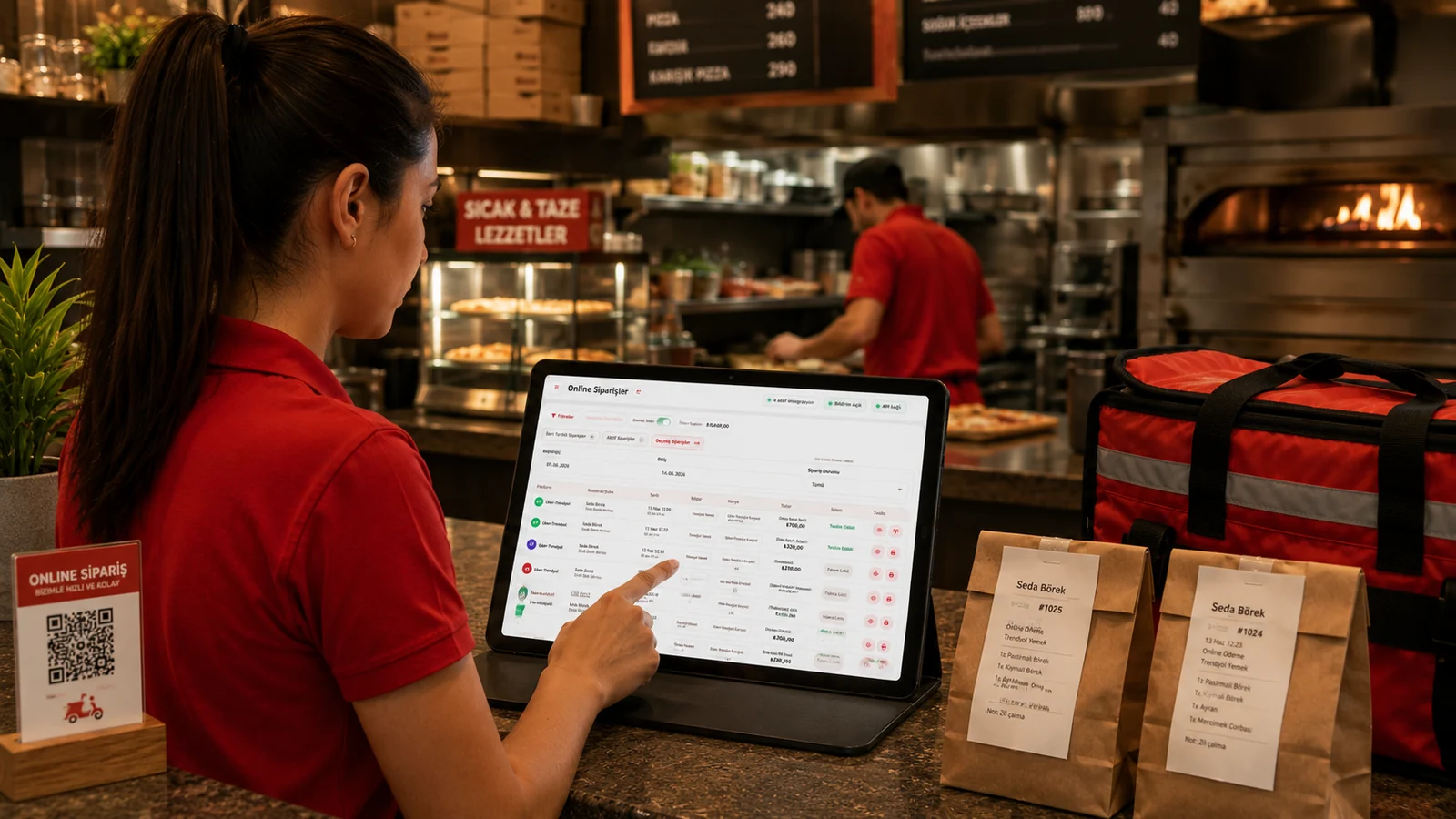
RoxPos pulls Yemeksepeti, Getir, Uber Eats (Trendyol) and Migros Yemek orders into the same screen as your phone and QR-menu orders, so staff stop switching between separate apps and tablets. The practical win is not just convenience: a single list means a single confirmation step, a single prep clock and a single source of truth when a customer calls to ask where their food is.
Caller ID: knowing the customer before you speak
The phone is still the channel with the most friction, because everything is typed live while a hungry person waits. Caller ID removes most of that friction. When a known number rings, the system can surface the caller's name, saved address and past orders before anyone picks up, so the conversation starts with 'the usual to the same address?' instead of a two-minute interrogation.
RoxPos supports Caller ID so the customer card opens with the incoming call. The operational payoff compounds: fewer wrong addresses, faster order entry at peak, and a record that grows with every call rather than starting from zero each time.
From confirmation to kitchen: routing the order
A confirmed order should not be a slip of paper passed by hand. The moment an order is accepted, the prep clock starts and the right items must reach the right station. A combined platter that needs the grill, the cold station and the bar should print three tickets at three places at once, not one ticket that someone has to mentally split.
RoxPos routes items to the correct kitchen printer by product or station, so each line lands where it is made. This is the difference between a kitchen that flows and one where the bottleneck is the printer queue, not the cooking.
Courier assignment and tracking
The handoff from kitchen to courier is where time leaks invisibly. An order can sit on the pass for ten minutes because no courier was assigned, or a courier can leave with three bags and forget the fourth. Clear assignment fixes ownership: every order has a named courier and a status, and dispatch can see at a glance who is out, who is back and what is still waiting.
RoxPos provides courier assignment and status tracking inside the same delivery screen, and because the platform is cloud-based with no installation, an owner can watch the board from a phone whether on site or off. A simple dispatch routine keeps the operation disciplined:
- Confirm the order and start the prep clock immediately.
- When the kitchen marks it ready, assign a named courier, not 'whoever is free'.
- Read back the bag count and any drinks before the courier leaves.
- Mark out-for-delivery so the delivery clock starts, separate from prep.
- Mark delivered on return, and let unusually long trips surface for review.
Measuring prep time and delivery time
You cannot improve what you do not split. Total order time hides where the delay lives, so separate it into prep time, the gap from confirmation to ready, and delivery time, the gap from out-for-delivery to delivered. When prep time blows out, the fix is in the kitchen or the menu; when delivery time blows out, the fix is courier count, zones or routing. Lumping them together leads to fixing the wrong thing.
RoxPos provides live reporting with PDF and Excel export and multi-branch comparison, so these timings become trends rather than guesses, and a chain can see which branch is slow and when. The table below summarizes the delivery KPIs worth watching weekly.
| Metric | What it measures | If it rises, look at |
|---|---|---|
| Prep time | Confirmation to ready | Kitchen staffing, menu complexity, station routing |
| Delivery time | Out-for-delivery to delivered | Courier count, delivery zones, batching |
| Order accuracy | Share of orders with no error | Entry process, read-back, address capture |
| Channel mix | Orders per channel and margin | Commission cost vs. own-channel volume |
Channel comparison: where each order actually costs you
Channels are not equal. Marketplaces deliver reach and demand but take commission and own the customer relationship; your own web and QR-menu orders carry no platform commission and keep the customer data in your hands, but you have to generate the demand yourself. A healthy operation runs both deliberately rather than letting the marketplace become the whole business by default.
- Phone: highest personal touch, best for regulars, but slowest entry; Caller ID is what makes it scale.
- Own web / QR menu: no commission, your data, but you drive the traffic.
- Marketplaces: instant reach and demand, at the cost of commission and customer ownership.
Stock, recipes and cost on every delivered plate
Delivery margins are thin, so the cost side has to be as automatic as the order side. Otherwise a busy weekend looks great on the order count and quietly loses money on under-priced items and over-ordered stock. Linking sales to inventory is what turns a delivery operation from a volume game into a margin game.
RoxPos ties stock, raw materials and recipes together: when an order closes, stock is deducted automatically and cost is tracked with the AVCO method, so the profit on each delivered item is real rather than estimated. Combined with AI features such as sales forecasting and profit-loss analysis, that lets you prep the right amount before the rush instead of guessing.
Common mistakes that quietly drain a delivery operation
Most delivery problems are repeat offenders. They rarely show up as a single dramatic failure; they show up as a slow drift in your KPIs and a rising trickle of refunds and one-star reviews. Naming them is the first step to designing them out of your process.
- Working channels in separate screens, so the same item gets prepped twice or missed entirely.
- Not starting the clock at confirmation, so you never learn where time is lost.
- Dispatching couriers ad hoc with no named owner per order.
- Re-typing repeat customers from scratch instead of using Caller ID and the saved card.
- Treating all channels as equal margin and ignoring commission in the pricing.
Delivery management with RoxPos
RoxPos's delivery management brings Yemeksepeti, Getir, Uber Eats (Trendyol) and Migros Yemek orders onto the same screen as your phone and QR-menu orders, recognizes the caller with Caller ID, routes confirmed orders to the kitchen, and handles courier assignment and tracking from a single panel. You can try it free for 15 days and start with no installation.