
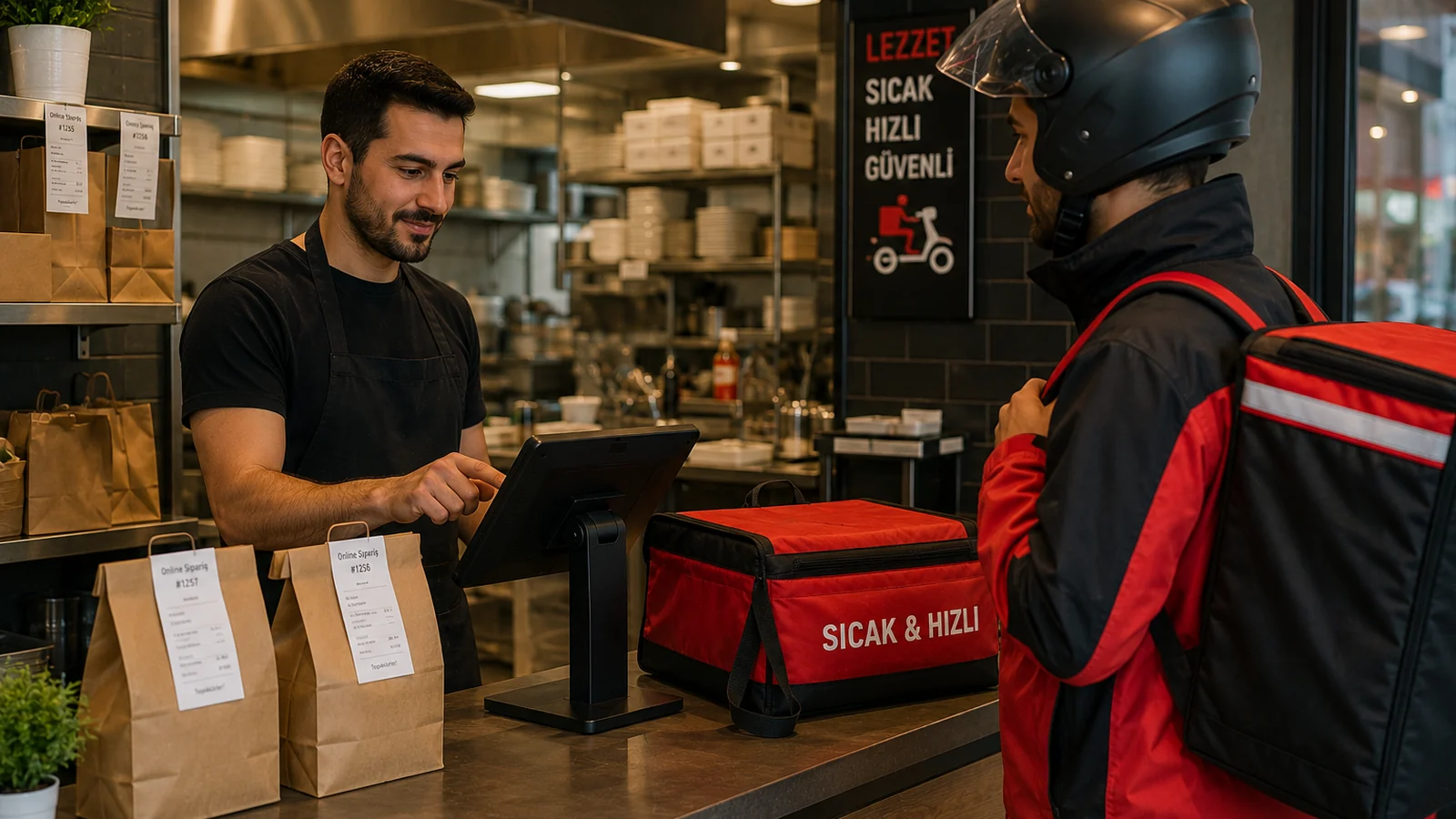
As food delivery apps spread, some businesses asked a simple question: if most orders go to people's homes anyway, why pay for a dining room, waiting staff and high-street rent? The ghost kitchen was the answer. In this guide we explain what a ghost kitchen is, how terms such as dark kitchen and cloud kitchen differ, the main types of the model and how a ghost kitchen works day to day.
What Is a Ghost Kitchen?
A ghost kitchen is a food production kitchen with no dining room where guests could sit and eat; it prepares orders only for delivery or collection. Orders mostly come from delivery platforms, by phone or through the business's own online channels; the food is prepared, packed and sent out with a rider, or the customer collects it. Customers never see the kitchen: they know the brand from the menu, photos and reviews in the app. The brand exists online, but has no shop front on the street.
The difference between a ghost kitchen and a classic takeaway restaurant is the dining room. A takeaway or delivery restaurant usually serves both tables and homes; a ghost kitchen handles only delivery and collection orders. So location, kitchen layout, menu and pricing are all planned around those orders.
Dark Kitchen, Ghost Kitchen, Cloud Kitchen: Are They the Same?
Several names are used for this model. In everyday use most of them mean the same thing; the small differences are in the table below:
| Term | What it means |
|---|---|
| Delivery-only kitchen | A plain description of the model: a kitchen without a dining room that cooks only for delivery and collection. |
| Cloud kitchen | Another common name for the same model; the brand lives "in the cloud", online. |
| Dark kitchen | Stresses that the kitchen is closed ("dark") to guests; usually used in the same sense as ghost kitchen. |
| Ghost kitchen | The kitchen guests never see. Sometimes also used for several virtual brands run from one kitchen. |
| Virtual kitchen / virtual restaurant | A brand or restaurant that exists only online; it can run from a ghost kitchen or from an existing restaurant's kitchen. |
In short, "what is a ghost kitchen" and "what is a dark kitchen" have largely the same answer. The difference is whether the term stresses the kitchen (ghost, dark or cloud kitchen) or the brand (virtual restaurant, virtual brand).
Types of Ghost Kitchen
- Single-brand ghost kitchen: A business opens a kitchen that sells only for delivery under one brand. It is the simplest model; menu, operations and reporting follow one brand.
- Multi-brand ghost kitchen: The same kitchen sells under several brands that share ingredients, for example a burger brand and a chicken wrap brand using the same buns and sauces. On the platform they look like two separate restaurants.
- Shared kitchen: One building offers separate kitchen units to several businesses; each runs its own brand in its own kitchen, while the building and common areas are shared.
- Virtual brand inside a restaurant: A restaurant with a dining room opens a second, online-only brand using its existing kitchen. With no new rent or fit-out, it is the lowest-cost way into the model.
In RoxPos you can connect several accounts on the same delivery platform and tell them apart in the order list by their display names, so a multi-brand kitchen still works from one screen.
How Does a Ghost Kitchen Work?
A ghost kitchen's day follows a different flow from a restaurant with a dining room: the order lands on the screen, the kitchen cooks, and the bag waits for the rider at the pick-up point. A typical order goes through these steps:
- The customer orders through a delivery platform, by phone or through the business's own channel.
- The kitchen accepts the order, manually or automatically.
- Items go to the right station on a kitchen ticket or the kitchen display (KDS).
- The food is prepared, packed and marked as ready.
- The platform's rider or the business's own driver collects the bag; the order closes once delivered.
Most of the time in this flow is lost between screens: a separate tablet for each platform, handwritten tickets, forgotten acceptances. That is why a system that brings orders into one screen is almost essential for a ghost kitchen. We list what to look for in our guide to choosing takeaway and ghost kitchen software.
Advantages of a Ghost Kitchen
- No dining room or shop front: No high-street unit, dining room fit-out or front-of-house staff; location is chosen for the delivery area, not for visibility.
- Fast experiments: Testing a menu, a price or a new brand is easier than in a restaurant with a dining room; a dish that does not sell is dropped, a new brand is opened on the platform.
- Better use of kitchen capacity: The same kitchen and team can serve several brands or a wider delivery area.
- Data-driven management: Every order arrives digitally, so you can measure which item sells, when and on which platform.
Risks and Drawbacks
A ghost kitchen may look cheap to run, but it has its own risks, and they should be factored in before you start:
- Platform commission: If most orders come through platforms, commission is taken from every order. If menu prices ignore it, even busy nights can be unprofitable.
- Platform dependency: The customer relationship and visibility largely sit with the platform; ranking, promotions and ratings directly affect sales.
- Packaging quality: Customers eat minutes after the food leaves the kitchen. Food that travels badly, poor packaging or late delivery quickly pull ratings down.
- Kitchen discipline: With several platforms and brands running at once, mixed-up orders, sold-out items and late acceptances happen more often.
Who Is a Ghost Kitchen For?
A ghost kitchen makes sense for restaurants where delivery is already a large share of sales, for businesses that want to test a new brand at low risk and for founders who want to focus on delivery in areas where dining-room rent is high. Where guests come for the place itself, such as cafés and restaurants built around their atmosphere, a ghost kitchen is better treated as an extra sales channel. Before opening, check the food business registration and licensing rules of your country and local authority.
Running a Ghost Kitchen with RoxPos
RoxPos brings a ghost kitchen's daily work into one system. In Ireland and the UK, orders from Flipdish, Deliveroo and Uber Eats arrive in one list (available platforms depend on the country). Accepted orders appear on the kitchen display with the platform name; once platform items are matched to your products, stock and recipe ingredients are deducted with every order. You can close or reopen the restaurant on the platforms from RoxPos, and on Flipdish an item that falls below its critical stock level can be switched off automatically. RoxPos is cloud-based, needs no installation and can be tried free for 15 days; see the pricing page.